
01 / Origin
I wanted Elvish to behave like a real language.
Sindarin Scholar began with a fairly simple fascination.
I have always been drawn to Tolkien’s languages, linguistics, ancient writing systems and the process of reconstructing meaning from incomplete evidence — the same instinct that makes the Rosetta Stone and Ancient Egyptian so compelling.
At some point I stopped wanting to merely read about Elvish. I wanted to use it.
What I discovered was that Sindarin is extraordinarily rich, but it does not exist as one finished modern language that can simply be picked up and used without interpretation. The surviving material spans different periods, revisions and incomplete areas.
So I began building a coherent working dialect of my own — grounded as closely as possible in the available linguistic material, and supported by technology that could help organise, compare and reconstruct that material systematically.
That became Sindarin Scholar.
02 / Question
Can an unfinished language be made genuinely usable without pretending that uncertainty does not exist?
Sindarin is recognisable as a language. It has vocabulary, grammar, history, sound, structure and a distinct character.
But it was never handed down as one finished modern dictionary with every question resolved. The available linguistic material developed over time. Forms changed. Ideas were revised. Some areas are richly documented while others remain incomplete.
That creates a difficult problem for anyone trying to use the language as a coherent whole.
The challenge was not simply to collect words. It was to build something that could distinguish between what is supported by source material, what can reasonably be inferred, and what requires modern authorship.
03 / The Problem
Turning fragments into a usable language means balancing clarity with provenance.
Collecting vocabulary is relatively easy. Deciding what to do when the evidence is incomplete is harder.
Some forms are well established. Others changed over time. Some areas require interpretation, and eventually there are places where a practical language needs a decision that the surviving material simply does not provide.
A usable language wants clarity. Research wants qualification.
If every uncertainty is removed, the result may be convenient but intellectually dishonest. If every uncertainty dominates the system, the material may remain defensible but become almost impossible to use.
Sindarin Scholar was built around that tension.
SourceMaterial directly supported by the linguistic record.
InterpretationA reasoned reading of that evidence.
AuthorshipA deliberate modern decision where the surviving material does not provide a complete answer.
The central question became: How do you make the language usable without pretending that every modern decision came from Tolkien?
That distinction became one of the core design principles of the project.
04 / The System
A linguistic reconstruction system with provenance built into it.
Sindarin Scholar became more than a dictionary project.
It is an AI-assisted linguistic system designed to help organise source material, compare linguistic evidence, support reconstruction and turn that research into a coherent working dialect.
The technology is not there to invent an authoritative version of Sindarin. It is there to help reason across incomplete and historically layered material while preserving the distinction between evidence and reconstruction.
The system is intended to answer practical questions such as: What word should be used here? What does this form mean? How secure is that interpretation? Is this supported, reconstructed or newly authored?
The goal is not to claim a definitive version of Sindarin. The goal is to create a coherent, practical dialect that remains honest about where its decisions came from.
05 / Method
Preserve the evidence. Make the decision visible.
The project follows a simple working principle: Evidence first. Reconstruction second. Authorship acknowledged.
Where the source material provides a strong answer, that evidence leads. Where multiple possibilities exist, the uncertainty remains visible. Where reconstruction is necessary, the reasoning should remain distinguishable from the source material. And where the dialect genuinely needs something new, that contribution is treated as modern authorship rather than retroactively attributed to Tolkien.
AI assists the reconstruction process, but it does not erase that distinction.
This creates something more useful than either extreme. It is not merely an archive of linguistic fragments. And it is not a fictional dictionary pretending every historical gap has been solved. It is a working language-research system with provenance built into its logic.
R&D Window / Sindarin Scholar
R&D WINDOW / SINDARIN SCHOLAR
A small snapshot from the Scholar research process: candidate language is examined, sourced, questioned and classified before it can become part of the working dialect.
R&D SNAPSHOT · PENDING SCHOLAR VERIFICATION
SPECIMEN / 01
Candidate Admission Review
Admission rule: No candidate enters Volume I until the underlying Tolkien source, wording, gloss and historical stage are directly verified.
| Candidate | Claimed meaning / gloss | Part of speech | Claimed Tolkien source trail | Historical / evidential concern | Required verification | Status |
|---|---|---|---|---|---|---|
| Adan | Man, as a species | noun | PE17/18; WJ/387; SA/adan; additional trails | Species term rather than specifically “male”; exact Tolkien gloss must control | Check PE17/18, WJ/387 and SA/adan directly | REVIEW REQUIRED — Evidence missing — review required. |
| adar | father | noun | PM/324; VT44/22; VT48/17 | Earlier Noldorin/Gnomish forms exist; only later Sindarin evidence may govern admission | Check PM/324 and VT44/22 directly | REVIEW REQUIRED — Evidence missing — review required. |
| aglar | glory, brilliance, splendour, radiance | noun | Let/448; LotR/238, 953; PE17/24, 105, 124; SA/aglar; RGEO; VT47/13 | Strong source trail, but several contexts and glosses must be distinguished rather than merged automatically | Check SA/aglar, the LotR usage, PE17 notes and Letters independently | REVIEW REQUIRED — Evidence missing — review required. |
| aen | should, could | adverb / modal particle | AotM/62; SD/129 | Meaning is explicitly uncertain in the finding-aid layer and may represent contextual interpretation rather than a Tolkien-supplied gloss | Verify manuscript wording and determine whether the modal meaning is directly supported | REVIEW REQUIRED — Evidence missing — review required. |
| amarth | fate, doom | noun | PE17/66, 104, 114, 123–124; PE18/92; S/224; SA/amarth; VT41/10; NM/227–228 | Variant ammarth and extensive name-element evidence require exact form/gloss control | Check SA/amarth and PE17 first | REVIEW REQUIRED — Evidence missing — review required. |
| aníra- | to desire; desires | verb | AotM/62; SD/129; VT39/34 | The finite form is attested in the source trail; the dictionary headword aníra- may be a scholarly normalization rather than a directly supplied Tolkien lemma | Determine whether Tolkien explicitly gives the base verb or only inflected forms | REVIEW REQUIRED — Evidence missing — review required. |
| Anor | Sun | noun / proper celestial name | PE17/30, 38, 55; RC/297; SA/nár; LotR index trails | Common-noun versus proper-name status and capitalization require an explicit project decision based on the primary evidence | Check SA/nár and PE17/38 directly | REVIEW REQUIRED — Evidence missing — review required. |
Why the classifications matter
None of these forms is being rejected. None is being presented as accepted merely because a modern linguistic database reports it.
Source trailWhere Tolkien evidence is reported to exist.
AttestationWhat the Tolkien source actually says.
InterpretationWhat scholars infer from that evidence.
NormalisationA convenient dictionary form inferred from attested forms.
ReconstructionLanguage deliberately generated beyond direct attestation.
AuthorshipLater choices belonging specifically to the reconstructed dialect.
At this stage of the preserved R&D record, none of these candidates had crossed the direct-source admission gate.
101 LETTER-A CANDIDATES · 0 ACCEPTED · 0 RECONSTRUCTIONS
R&D-state statement, not a permanent live-corpus metric.
06 / Why It Matters
Sindarin is the subject. Knowledge engineering is the larger problem.
The underlying challenge extends far beyond Elvish.
Many knowledge systems begin with information that is incomplete, contradictory, historically layered or unevenly documented. The difficult question is often not: Can we produce an answer? It is: Can we produce a useful answer without destroying the distinction between evidence and interpretation?
Sindarin Scholar became a compact environment for exploring that problem. It combines linguistic research, structured knowledge and AI-assisted reconstruction to turn fragmented specialist material into something operational.
The broader Ravenwood capability is the same: turning incomplete or complex knowledge into a structured system that remains useful without erasing where its conclusions came from.
SPECIMEN / 02
Authored Sindarin / Language Trial
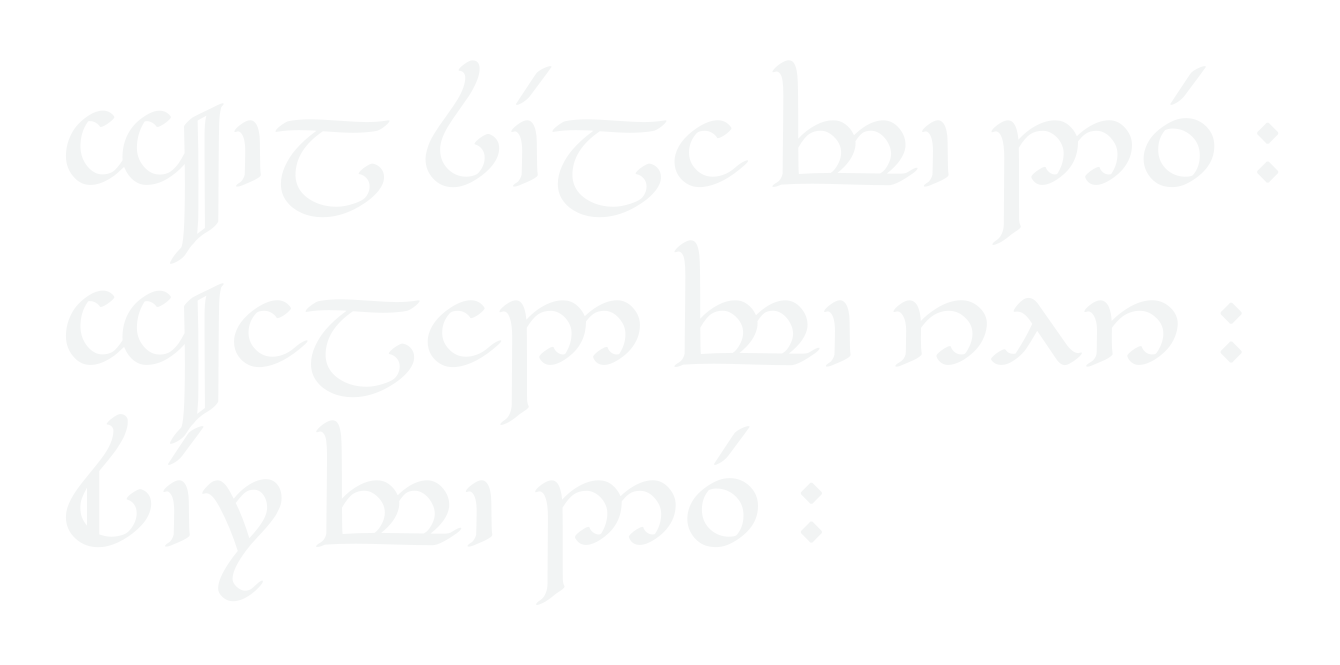
Latin script
Gil síla vi dû.
Galad vi nen.
Sîr vi dû.
English
A star shines in the night.
Radiance in the water.
A river in the night.
Composition status
Modern authored specimen. The three-line composition is not Tolkien-attested.
gil — “star.” Tolkien-source trails include RGEO/65, VT42/11 and PE17/152.
síla — “shines.” An attested present form in Lúthien’s Song, LB/354.
mi / vi — “in.” vi is an attested mutated form of mi.
dû — “night, dimness.” Tolkien-source trails include PE17/152 and SA/dú.
galad — “radiance, glittering reflection.” Late derivational account associated particularly with PM/347.
nen — “water.” Later Tolkien-source trails include PE17/52 and VT42/14.
sîr — “river, stream.” Tolkien-source trails include PE17/37 and SA/sîr.
The component vocabulary and morphology have Tolkien source trails. The selection, juxtaposition and poetic meaning of the passage are modern authorship.
This is an R&D language trial, not a Tolkien quotation and not a representation of accepted Scholar corpus material.
07 / Current State
Complete / Operational
Sindarin Scholar now exists as an operational linguistic system for researching, testing and reconstructing the dialect.
Its lexicon is intentionally evidence-gated: candidate entries are only promoted when their source, gloss and historical stage have been directly verified.
What began as a Tolkien fan wanting to understand and actually use Elvish became a functioning research system for organising linguistic evidence, testing reconstruction decisions and developing a coherent working dialect while retaining the difference between source evidence, interpretation, reconstruction and modern authorship.
The project does not claim that every uncertainty in Sindarin has disappeared. That would defeat the point.
Instead, it explores whether a language can become genuinely usable without requiring false certainty about its origins.